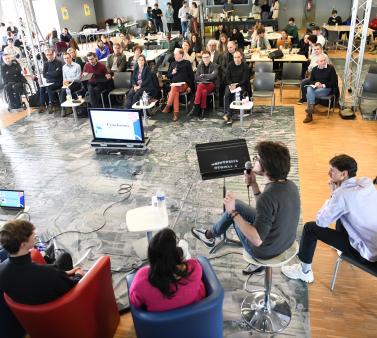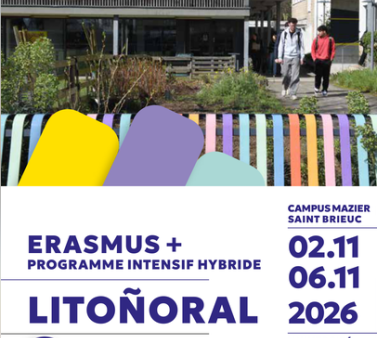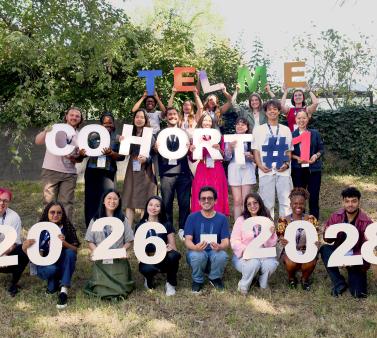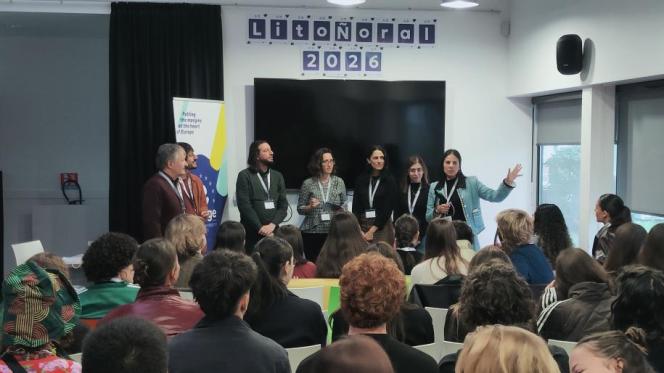
The in-person phase of the LitoÑoral BIP kicks off at the Mazier campus. Photo credit: Marie-Florine Dambakizi.
Designed by two lecturers from Rennes 2 University's Department of Applied Foreign Languages (LEA), Juanita Robayo Beltrán and Maria Lomeña Galiano, this Blended Intensive Programme (BIP) was organized in partnership with two other universities within the EMERGE Alliance: Europa-Universität Flensburg (Germany) and Universidade da Coruña (Spain).
The program also benefited from contributions from valued local partners, who shared their practical expertise with the participants.
We spoke with the program's organizers about the challenges and rewards of bringing students from across Europe together to learn, collaborate and explore coastal resilience.
Teaching innovation and the challenges of blended learning
How did you combine the online learning activities with the intensive in-person week in Saint-Brieuc?
Juanita Robayo Beltrán and Maria Lomeña Galiano: First, we worked with three expert groups: one Spanish group, one French group and one German group. The latter also included students from Université Bretagne Sud (UBS) in France, as well as students from Ireland and Greece.
The aim was to introduce students to the specific characteristics of each country's coastline so that they could then share this knowledge with their peers from other countries. Various aspects were explored, including history, geography, language, music, gastronomy, environmental issues affecting coastal areas, literature and culture.
In the second phase, we all met online. We introduced the teaching team, presented the program for the week and outlined the planned activities. We then took part in an icebreaker activity. Finally, we held a session with the students to go over practical arrangements, including accommodation, transportation and meals.
How did you build group cohesion before the students even met in person?
Juanita Robayo Beltrán and Maria Lomeña Galiano: The online meeting helped foster connections between the students and the teaching team, especially through the icebreaker activities. It also sparked students' curiosity and enthusiasm for taking part in the BIP.
"The online sessions gave us the opportunity to get to know the group we would be spending the week with, which made meeting everyone in person afterward feel less daunting. The transition was very smooth, and the field trips gave the week a good rhythm, alternating between working on our project, conducting field observations and engaging in discussions with professionals."
Yannaëlle Le Faou, Master's student in Spanish, Iberian and Latin American Studies, Université Bretagne Sud (UBS)
How do hands-on activities, such as a guided tour of Fort La Latte or fieldwork challenges, help students develop their academic and scientific understanding of coastal resilience?
Juanita Robayo Beltrán and Maria Lomeña Galiano: Field visits to places such as Binic-Étables-sur-Mer, Fort La Latte and the Maison de la Baie (at the Bay of Saint-Brieuc nature reserve) gave students the opportunity to move beyond theory and explore the coastline of the Côtes-d'Armor region firsthand, discovering its history, heritage and natural environment.
These visits enriched the academic discussions and learning activities (lectures, talks and workshops) by providing students with immersive learning experiences and new insights. We believe that taking an active role in one's own learning opens up new perspectives. It allows students to see, touch and experience things for themselves, helping them acquire knowledge and skills and put them into practice.

Students visiting Fort La Latte as part of the LitoÑoral BIP. Photo credit: Sébastien Boyer.
Giving a three-minute pitch in front of a panel of judges is a demanding exercise. How does this presentation format help students develop key soft skills compared with a traditional university exam?
Juanita Robayo Beltrán and Maria Lomeña Galiano: Pitching is a challenging exercise that helps students organize their thoughts while summarizing an entire week's work. It brings together ideas, language skills and creativity to deliver an engaging presentation within a limited time frame. It also encourages teamwork, develops public speaking skills and requires the use of precise vocabulary.
The students delivered innovative and creative pitches that, above all, encouraged greater awareness of the importance of protecting and preserving coastal areas.
The European dimension and intercultural exchange within the EMERGE Alliance
The program was conducted entirely in Spanish, with students from several European universities. How did this shared language become a tool for inclusion and effective collaboration among such a diverse group of students?
Juanita Robayo Beltrán and Maria Lomeña Galiano: During BIPs, we usually work in English, as it is the language of international communication. However, given our own expertise, we wanted to deliver this program entirely in Spanish. Spanish plays an important role on the international stage and is our working language, so it was only natural to give it center stage.
Beyond helping students develop their language skills, Spanish became a common language for students from A Coruña and those from the other universities. It enabled them to communicate, exchange ideas and work together to successfully complete their projects.
Coastal challenges vary across European countries. How does the geographic and academic diversity of students from the EMERGE Alliance contribute to finding solutions to environmental challenges?
Juanita Robayo Beltrán and Maria Lomeña Galiano: This diversity brings not only different areas of knowledge and expertise but also different ways of living and seeing the world. These differences are a real asset for this type of project, as they allow students to share their understanding of the challenges facing different regions and the solutions that have already been implemented.
Combining teaching and learning with geographic and academic diversity fosters collective intelligence and helps students develop critical thinking skills.
We are not going to find miracle solutions in just a few days. However, our work aims to encourage students to question the societies and communities in which they live, while giving young people a voice. In doing so, we hope to plant the seeds that will help our students become European citizens who are aware of the challenges ahead.
"The BIP was an excellent opportunity for me to practice my Spanish while exploring a specific topic, which I find particularly relevant to my trilingual degree program. [...] I particularly enjoyed the birdwatching trip near the Maison de la Baie. It was wonderful to learn about the local flora and fauna at the museum and then have the opportunity to observe different species firsthand in their natural environment."
Gregor Dittmann, European Transcultural Studies, University of Strasbourg / Europa-Universität Flensburg
Lessons learned and the future of blended learning programs
If you had to summarize the impact of the LitoÑoral BIP on the students' development, what would it be?
Juanita Robayo Beltrán and Maria Lomeña Galiano: The impact on students' development has been considerable in several respects:
- Linguistic development: We have observed a boost in students' confidence. They have realized that they are capable of working in a foreign language alongside native speakers. They have expanded their vocabulary and discovered idiomatic expressions. They have also had to find the right words to explain complex concepts and ideas.
- Personal development: Students have learned how to work in groups, collaborate, reach a consensus when making decisions and overcome interpersonal challenges.
- Cultural development: Participants have discovered cultural differences and learned to work with different methods and tools.
- Professional development: This experience is a valuable addition to their CVs. It demonstrates their ability to adapt to an international, intercultural and multilingual environment.
Overall, students have developed essential skills such as communication, creativity, critical thinking, adaptability and time management. They have also strengthened their ability to work as part of a team, take initiative and find solutions collectively.
How did the local partners experience the program?
Juanita Robayo Beltrán and Maria Lomeña Galiano: We worked with local partners at different stages of the program and in various ways. This collaborative approach also helped showcase the diversity of the local area. The feedback has been very positive, both in terms of the international experience and the topic itself, which is particularly relevant to our region.
Could this teaching approach be replicated or continued within the EMERGE Alliance?
Juanita Robayo Beltrán and Maria Lomeña Galiano: Yes, our colleagues at Europa-Universität Flensburg and Universidade da Coruña may host a future edition of the BIP.