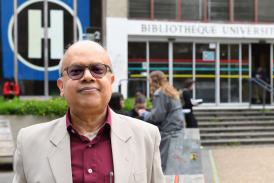
Pictured: Professor Subarno Chattarji
Professor Subarno Chattarji studied at the universities of Delhi and Oxford, and has held prestigious fellowships, including Fulbright Senior Research Fellow at La Salle University, Kluge Postdoctoral Fellow at the Library of Congress, and a residency at the Rockefeller Foundation Bellagio Center. He is a Project Researcher for the International Program on Holocaust and Genocide Education (IPHGE) in India, a member of the UNESCO Informal Academic Network on Genocide Education and Prevention, and an advisor to UNESCO’s project ‘Addressing Violent Pasts through Education’. His publications include Holocaust Education in India: Fostering Peaceful, Resilient, and Inclusive Societies (2024), The Distant Shores of Freedom (2019), and Memories of a Lost War (2001).
Could you briefly introduce your main research interests and what draws you to the study of war and conflict in literature and media?
My primary research interests are literary and media representations of war, Holocaust education in India, and English Studies in India. Of these areas, the study of war and conflict is one I have engaged with the longest. I analyze the ways in which wars proliferate across cultures and geographies and their impacts on people and nations.
I am especially interested in how wars are remembered and what these memorializations tell us about a nation and its peoples. Wars do not end with the cessation of hostilities; they affect not only combatants but civilians as well. The aftermaths of war and conflict have intergenerational resonances, and I am interested in how these memories are passed down over time.
Literary representations create alternative memories and counter-histories, enabling us to consider realities and interiorities that are not represented in standard histories or mainstream media. Literature also enables us to step back from the tide of misinformation and disinformation on social media, creating spaces for reflection and enabling alternative modes of consciousness.
A significant part of your work focuses on the Vietnam War and its literary and cultural representations. What aspects of this topic are you currently exploring in your research?
I am working on a project that examines a body of poetry written after the Vietnam War by Vietnamese refugees and immigrants in the United States. This study is significant because the Vietnam War is primarily represented in the US from American perspectives, whereas the poetry I read offers alternative points of view.
My analysis will offer a comparative frame by analyzing some Vietnamese poetry in English translation. This opens up a complex field in which voices from Vietnam challenge dominant communist narratives. Vietnamese American poetry, alongside translated works, thus creates polyphonic counterpoints to the relative monophony of both American and communist perspectives.
Post-war Vietnam is as complex an entity as it was during the war and there has been a concerted effort since the early 1980s to make Vietnamese representations of the war and its aftermaths available to an English reading audience, primarily in the US. I am interested in examining why this is the case and what it reveals about processes of memory-making.
You are currently a visiting professor within the Research-Action Chair Doctor Denis Mukwege. How does your work resonate with the themes of the Chair, particularly in relation to conflict, memory, and representation?
My work is interdisciplinary and focused on individual and collective memories of violence and its aftermaths. In studying various narratives of and about survivors of war and conflict, my research aligns with the themes of the Research-Action Chair Doctor Denis Mukwege. It is grounded in analytical frameworks that address violent, often gendered, events. Beyond literary analysis, my work is deeply invested in pedagogy and learning, aiming to transmit knowledge and memory to students and other interlocutors.
In my work on Holocaust education as part of the International Program on Holocaust and Genocide Education, which is a UNESCO project, I have co-authored a teacher training guide for secondary school teachers in India. This work enhances pedagogical training and has the potential to transform mindsets, not just with reference to the Holocaust, but to issues related to discrimination, hate speech, and gendered violence.
How did your collaboration with Rennes 2 begin, and what have been your main teaching or research activities during your stay?
My collaboration with Rennes 2 began in 2014, when I was invited to present a paper at the international conference “War Memories: Commemoration, Re-enactment, Writings of War in the English-Speaking World (18th–21st Centuries)”, coordinated by Professor Renée Dickason of the Anglophonie: Communities, Ecritures (ACE) research unit of Rennes 2.
I subsequently participated in two further conferences in the War Memories series, in 2018 and 2021, and was invited to serve on the Scientific Committee of the War Memories network, as well as on the editorial board of Revue LISA, the online journal published by Rennes 2. I also contributed to Mélanges in homage to Pr. Dr. Denis Mukwege (2020), and in 2025 co-edited a special issue, “War and Representation in India,” for Revue LISA.
During my current stay at Rennes 2, I will have presented four seminars on the following topics: ‘Re-envisioning survival: thinking of survival and “healing” after war’; ‘Teaching and learning about histories of the Holocaust and its impact in India’; ‘Representing War’; and ‘Poetry and War.’
The discussions following these seminars have been particularly enriching, and the depth of engagement has encouraged me to think about my research in new ways. I have benefited from the multidisciplinary expertise of participants, whose perspectives ranged from memories of the Holocaust in post-war East Germany to the education of young adults about gendered violence.
These exchanges have continued beyond the seminars, and I am hopeful that the academic networks established during this time will continue to develop.